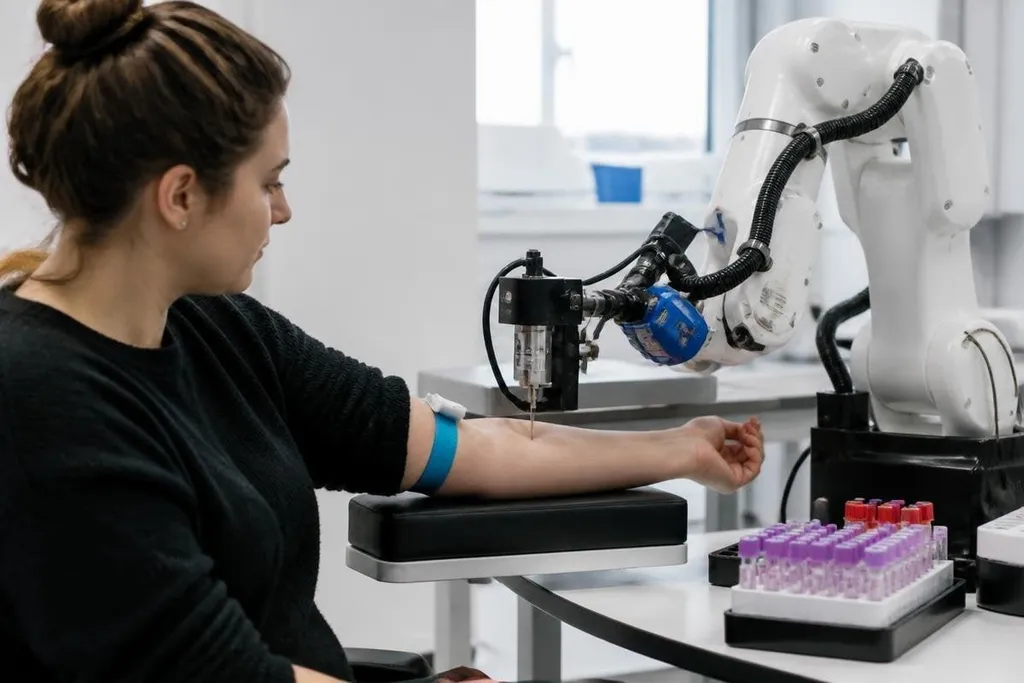
A robot can move a needle, hold a tube, and follow a programmed path. Drawing blood from a person needs more: the system must find a vein, adjust to movement, and stop when something changes. That makes blood collection a sensing and safety problem, not only an arm-motion task.
- The target moves: skin and veins shift as the arm rests or tenses.
- The process has stages: positioning, needle entry, tube filling, removal, and labeling all need checks.
- The weak point: a robot can repeat a path, but a person’s arm won’t behave like a fixed part.
What the robot would need to do
A blood-sampling robot would first need to position the arm. That could involve a support for the elbow, a tourniquet, and a camera or ultrasound sensor that helps locate a vein. The system would then need to keep the arm still without pressing hard enough to cause pain.
The needle needs controlled motion in more than one direction. It must move toward the vein, enter at a suitable angle, and stop at the right depth. A small error can cause a failed draw, a bruise, or a needle that moves inside the arm.
After entry, the robot still has work to do. It must hold the needle steady while blood enters a collection tube, detect a blocked line or poor flow, remove the needle, and place pressure on the site.
Each step creates a separate point where a sensor or trained operator may need to intervene.
Why a fixed path isn’t enough
A programmed path works well when the object stays in the same place. A human arm can rotate, tense, or shift during the procedure, so the robot needs fresh position data while the needle is near the skin.
That data could come from a camera, force sensor, or ultrasound image. Each method has a different job. A camera can track the arm’s surface, a force sensor can detect contact, and ultrasound can show tissue below the skin. None of these signals removes the need for a safe stop.
The robot also needs a clear response to uncertainty. If it can’t see the vein, if the arm moves, or if the needle meets unexpected resistance, it should stop and call a trained person. A system that keeps moving after a bad reading would create more risk than the manual process it aims to replace.
Lab automation is a different task
Robots already fit many steps after blood leaves the body. A lab system can sort tubes, read labels, move samples between stations, and prepare them for tests. Those tasks happen in a controlled space, with known objects and no needle entering a person.
That difference matters when a company says its system can automate blood work. Sample handling and venipuncture are separate problems. The first concerns tubes and lab equipment; the second concerns living tissue, pain, movement, and immediate clinical decisions.
For this question, medical robotics coverage from Robot24.com can put a company’s claim beside the exact task and test record. A video of a robotic arm moving a tube shows sample handling. It doesn’t prove the arm can draw blood from a patient.
The limits that still need proof
A working demonstration would need to show more than a needle reaching a marked spot. It would need clear results across different arms, skin types, vein positions, and patient movements. The report would also need to state who supervised the procedure and what happened when the first attempt failed.
No evidence pack was supplied for this article, so there’s no named robot, price, approval, success rate, or clinical trial result to cite. That absence matters: the question can be answered as an engineering problem, but a buying or deployment decision needs measured results from a real system.
I'd skip any product claim that shows only a robotic arm touching a training model. A useful test must show the full procedure, the safety stops, and the result after the needle comes out.
A practical check before deployment
Use these questions when a vendor presents a blood-sampling robot:
- Ask for the task boundary. Does the system find the vein, insert the needle, fill the tube, remove the needle, or handle samples after collection?
- Request trial data. Check the number of attempts, failed draws, injuries, and manual takeovers.
- Watch the full video. Look for the arm setup, needle entry, tube fill, removal, and pressure on the site.
- Check the stop system. Find out what happens when the patient moves, the vein is missed, or the force reading changes.
- Name the supervisor. Confirm which trained person can take control and how quickly they can reach the patient.
Those answers separate a medical robot from a lab-handling robot. The next useful proof is a supervised clinical test that reports success and failure across real patients, not a clean demonstration on a fixed training arm.